Patient Story
Robotic-Assisted Surgery Helps Tech Pro Lose Weight
Apr 28, 2025

From scaling back on sweets and carbs to working out in gyms and wave pools, Paulette Thorp, 67, tried for years to lose weight on her own. But nothing seemed to melt away the excess pounds that dragged her down and hampered her ability to get around.
At her highest weight, she’d wince in pain just walking a few steps. Her knees popped and hurt so badly, she couldn’t even stroll her favorite park trails, let alone travel or plan the European adventure of her dreams. Finally, after retiring from a 49-year career in computers, semiconductors, microelectronics and medical devices, she decided to seek help.
When she met Ryland Stucke, MD, surgeon at Adventist Health Portland, she had one key question: Do you do robotic-assisted weight loss surgeries?
Dr. Stucke replied with an encouraging ‘yes’ like Paulette hoped for. She then shared a fascinating detail with him: The highly-advanced instruments he uses in robotic-assisted surgeries are designed and developed at the very company where she had worked just a couple years prior.
For the first time in her weight-loss journey, Paulette began to believe hope could be around the corner.
Tech work comes full circle
“I worked in Silicon Valley when it was just the Valley,” she says. “It was the wild, wild west with computers. Companies were competing like crazy for employees and market space.”
Massive mainframes and equipment dominated rooms, computers couldn’t talk to each other yet, and big, bulky monitors displayed one of two color combos: either black and orange or black and green.
“Nobody could even think of having a computer in their home,” Paulette recalls. “A hard-disk drive was the size of a suitcase, and that was only about 16K of memory. We used to call them ‘boat anchors’ because they were so huge and heavy.
At North Star Computers, Paulette helped design, build and troubleshoot some of the earliest PCs. Engineers would leave for lunch and return with schematics sketched on napkins. Paulette would take the concepts, figure out which parts, power sources and connectors would work best, then build them. For some prototypes, she hand wired 10,000 tiny connection points onto one board—a labor-intensive but satisfying task.
After those early dinosaur days, computer tech took off—and Paulette’s career zoomed along with it. She switched companies to help manufacture even smaller, more sophisticated computer chips. Then she pivoted again 17 years later, this time to a job that would later impact her life directly: the field of medical devices.
At a California-based company called Intuitive Surgical, Inc., robotic instruments and software are developed, and surgeons from around the world receive specialized training in how to use them.
Paulette worked there as a senior quality control associate. She inspected and audited test results and documentation for every device in her queue, analyzing each part down to the tiniest detail. It was only when she personally signed off on a device that it was cleared for use in a medical setting.
One such system, the da Vinci surgical robot, is used by Dr. Stucke and other surgeons at Adventist Health Portland. Paulette believes she likely inspected the very machine that was used in her weight-loss surgery.
“I was releasing almost every machine around the time Adventist Health Portland acquired the da Vinci,” she recalls. “I’m sure I had my fingers in it and probably did the final sign-off.”
In another twist, Dr. Stucke and Paulette may have even been at Intuitive headquarters at the same time, unbeknownst to each other. Dr. Stucke is a proctor for the da Vinci and has traveled to Sunnyvale, CA where most of the surgical robots are produced. Chances are, on one of his trips, Paulette was there working in quality control.
It was a rare link indeed, and it paved the way for Paulette not only to ask informed questions, but to feel confident in her surgeon’s knowledge and expertise.
Talking shop
While working at Intuitive, Paulette tracked research, observed simulations and listened to surgeons talk about their findings and successes using the da Vinci. She decided then that if she ever needed surgery, she would look for a surgeon experienced in robotic-assisted procedures, ideally with the da Vinci.
“I’m really well-studied in the machine and I have a lot of personal confidence in it,” she says. “I know the instrumentation is top notch and the chance of complications is very low. The cuts are so small, the blood loss is much lower compared to regular surgeries, and there’s less scarring. It’s just not as hard on the body, and recovery is much faster.”
Other advantages include the scope and optical features of the da Vinci, she says. Doctors can visualize details better, both at a higher magnification and in 3-D, compared to what the human eye can see. The instruments are highly receptive and responsive, moving right along with the surgeon’s every prompt and intention.
In discussing her surgery with Dr. Stucke, Paulette asked several details about what the procedure would entail, which instruments he would use, and how he planned to handle various scenarios.
“He passed on all accounts,” Paulette says. “He knew what he was talking about, his experience showed, and I could tell it’s just normal for him to be using the machine. I asked him about complications and if he had ever had to convert to open surgery, which means they pull the instruments out and cut you open. He said he’s never had to do that and he hasn’t had any major complications using the da Vinci. I felt confident that he was the right doctor for me.
“We talked a little shop about the new generation of machines coming out. The new technology is unbelievable. We’re getting close to the Star Trek thing where they wave a wand over you and you’re better, but we’re not quite there . . . yet.”
From surgery plans to plane tickets
In the six months leading up to surgery, Paulette spent a lot of time preparing. She had medical appointments at least monthly, including visits with a psychiatrist, physical therapist and dietitian. She adjusted her eating patterns enough that even before surgery, she had already lost a fair amount of weight.
Finally, the big day arrived. On October 24, 2024, Paulette had gastric sleeve surgery at Adventist Health Portland. Dr. Stucke performed the procedure, which involved reducing the size of her stomach to lower food intake and change the hormones that help control weight. Everything went smoothly and uneventfully, as planned.
“I was up and around a couple days afterward,” Paulette says. A wrap around her belly maintained gentle support and pressure while the four tiny incisions healed. The external incisions didn’t need any stitches—just glue—and a slightly larger incision only required a few internal stitches.
“I didn’t have any complications,” Paulette says. “I think they gave me one dose of painkiller, and then I just took Tylenol a few times. I haven’t even had nausea or any of the other symptoms they talk about. They give you a list of things to buy ahead of time so you’re prepared, but I have a box of things I never used because I didn’t need to. Other than vitamins. I do take the vitamins every day.”
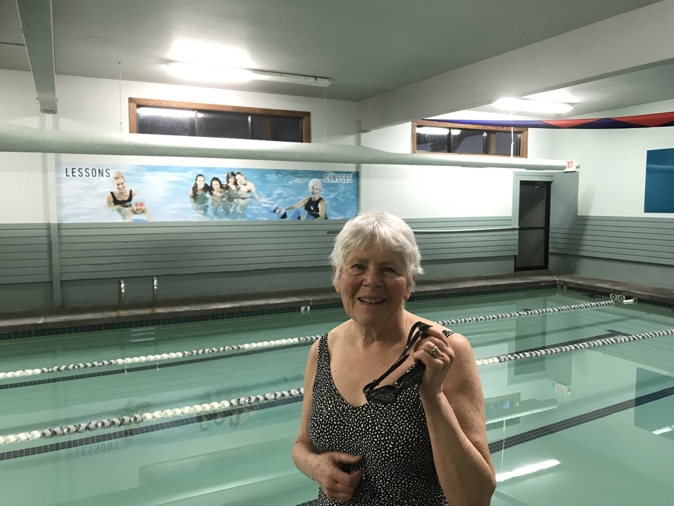
As for her weight, Paulette has lost 65 pounds so far, with only five more to come off before she qualifies as a candidate for knee replacement surgery. She’s back to low-impact water exercise and has already gone through about three wardrobe changes.
“It’s nice to be able to pick up clothes at Macy’s and not have to rely only on Lane Bryant plus sizes,” she says. “I’d like to lose 100 pounds total. The process is going fine, but it takes time and I have to be patient. I can only eat about three ounces, which is about the size of a deck of cards, then I’m full.”
The tradeoff is worth it though. She finds ways to make nutritious meals and snacks with plenty of protein—and with smaller portion sizes.
“I’ve learned that half a sandwich is too much,” she laughs. “Luckily, one of the places I like to go for lunch lets me order half a sandwich, so I’ll eat half of a half there, then take the rest home and eat it later.”
This year, Paulette hopes to have both knees replaced, then focus on recovering and rebuilding her strength. She can’t wait to take longer walks, travel more, spend time with family, and book those plane tickets to Europe for that long-awaited getaway.
Words of advice
Looking back, Paulette says she’s thankful for a career that ultimately pointed the way to a surgery – and a surgeon – that helped so much. She’s also happy that she went with a robotic-assisted route.
For people thinking about weight-loss surgery, Paulette offers these suggestions:
- Decide on your reasons. Figure out what you hope to gain from weight-loss surgery. For her, that was getting her mobility back, achieving better health, and building a more active future.
- Tell your truth. “There can still be a stigma about weight-loss surgery,” she says. “But I’ve found that the more open I am and the more freely I talk about it, the less of a big deal it is and the more understanding people are.”
- Purpose it in your heart. “If you’re going to have success long-term, you need to change your mindset,” Paulette shares. “Don’t just think you’ll go back to your old lifestyle after losing 100 pounds. Purpose in your heart to maintain it. Take care of yourself and stick with the plan. It’s a new and better life.”
- Find a team you trust. “Get a good surgeon who is very experienced,” she advises. “Adventist Health Portland has a great team and they will explain everything. You will likely have a happy result.”
To learn more about weight-loss surgery options at Adventist Health Portland, click here or call 503-256-1575.