New heart attack program providing lifesaving care in the Mother Lode
Apr 15, 2025
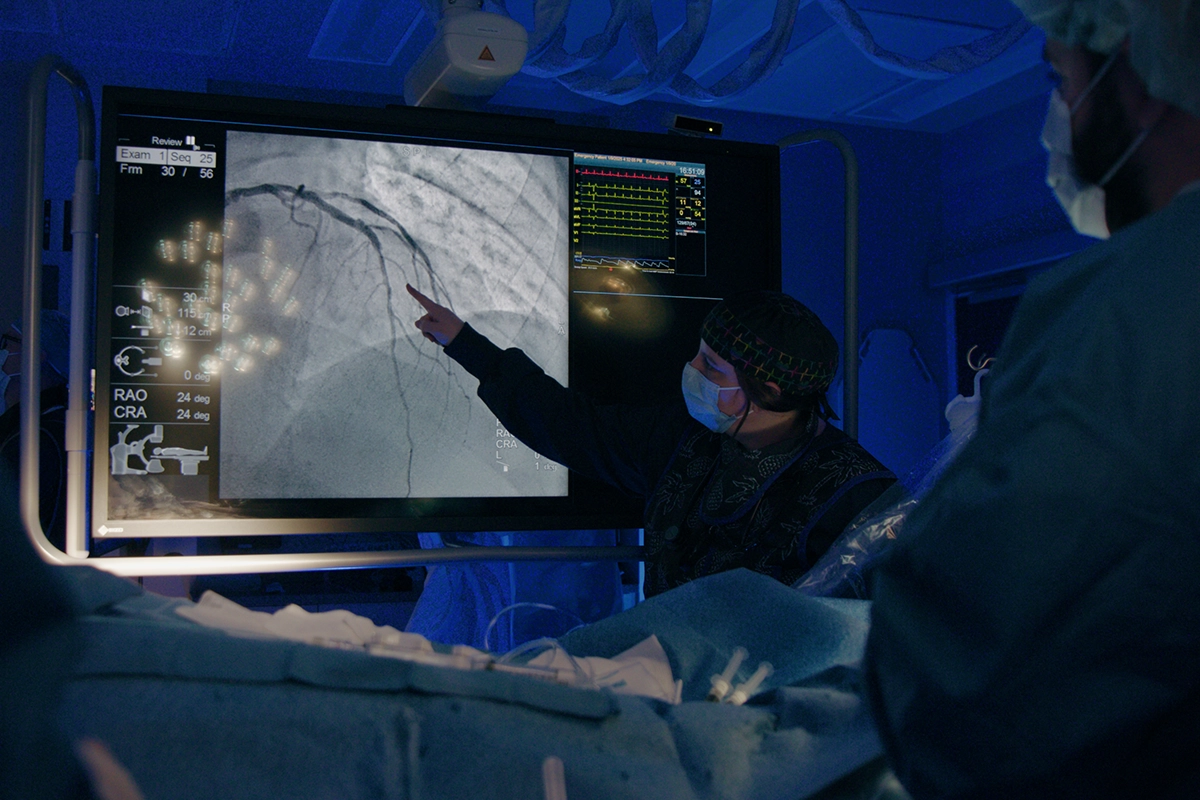
During a heart attack, a blood clot or other blockage in an artery prevents oxygen-rich blood from traveling to the heart and surrounding organs — and it’s critical to reopen the passage quickly.
“We say ‘time is heart,’ which means that every minute that the heart is not receiving the oxygen it needs to survive causes more tissue death,” says Sharon Watkins, DNP, RN, Patient Care Executive at Adventist Health Sonora.
For years, the closest hospital to Sonora that could do specialized procedures for a heart attack was an hour away. “If you think about it, that’s 60 minutes of transportation before you’re getting treatment,” Watkins explains, “and potentially an hour of tissue death.”
Now, thanks to investments in advanced technology and a local team of cardiology experts, people in the Mother Lode can travel just minutes from home to get quality cardiovascular care and emergency heart attack treatment.
Quick action
Last year, we became licensed to do interventional procedures in our cardiac catheterization lab for people having heart attacks. That means not only can providers do imaging procedures to find signs of heart disease and potential heart attack, but they can treat them, too. “In the lab, we inject dye to visualize the heart with imaging and see where the blockage is,” Watkins says. “But now we can also go in and perform procedures to fix it in real time.”
Common interventional procedures for a heart attack include balloon angioplasty, in which providers inflate a specially designed balloon to reopen the artery, and stent placement, in which a small mesh tube is placed to hold the artery open. Providers can also use intravascular lithotripsy, which uses sound waves to break up calcified deposits in the heart’s arteries.
Community-wide investment
When a cardiac emergency strikes, close coordination between first responders, physicians and staff is critical to ensuring the best outcomes for the patient.
That’s why we’ve also invested in partnerships and resources beyond our walls. This April, we became an officially designated STEMI Receiving Center and are now the closest such facility for more than 100,000 people in Tuolumne, Calaveras, and parts of Mariposa counties.
A STEMI (ST-elevation myocardial infarction) is a particularly dangerous kind of heart attack named for the way it changes the heart’s electrical activity on a diagnostic electrocardiogram (EKG) test. When a first responder identifies the telltale signs of a STEMI on a patient’s EKG, the ambulance is automatically routed to our hospital as the closest designated STEMI Receiving Center.
With the support of our Foundation’s Greatest Need Fund, we’ve partnered with Tuolumne County Ambulance Service to outfit local ambulances with new modem technology. Equipped with these devices, EKGs taken in the field can be transmitted directly to our emergency department where a physician can activate the cardiac catheterization lab team before the patient even arrives at the hospital.

Small enough to fit in the palm of your hand, this modem is making an outsized impact for local patients experiencing a heart attack.
Better outcomes
In a rural community where coronary artery disease is a leading cause of death, having this level of care in Sonora is saving lives. “When we’re able to act quickly, the heart is going to perform better in the long run,” Watkins says.
This is all part of our effort to provide full-spectrum cardiac care, from diagnosis to recovery. “If you need testing or you’re referred to a cardiologist, our cardiovascular clinic is here to help. And if you are treated for a heart attack, we’ll refer you to our cardiac rehabilitation clinic when you leave the hospital,” Watkins says. “It does your heart good to know that, from start to finish, we’re here for the people of our community.”
Watch Dale’s story
When Dale Robbins had a heart attack, he faced a choice: stay in Sonora for treatment, or travel to the Central Valley. In his most vulnerable moment, the decision was easy for Dale. There was nowhere he trusted more with his life than his hometown hospital.
Related articles
Technology & Innovation
An Epic Transition: Our New Electronic Health Record and What It Means for You
Technology & Innovation
More Convenience: Expanded Weekend Hours for Outpatient Pharmacy, Lab and Imaging Services in Sonora